

Your curtains don’t need to match your flooring, and in most rooms they’re better if they don’t. What matters is that the two coordinate: tones that share a temperature, enough contrast to give the room some depth, and a fabric that suits what’s underfoot. Below we cover the three principles that govern the pairing, then work floor by floor through timber, hybrid, vinyl and carpet.

Should Your Curtains Match Your Flooring?
No, and trying to is the most common way this goes wrong. Coordinate them instead.
It’s one of the questions we hear most often in Solomons showrooms, usually from someone who has already settled on their floor and is now holding fabric samples up to the light. The instinct is to find a curtain that matches the boards. But when the fabric picks up the same tone as the floor, the two surfaces read as one flat block, and the room loses the layering that makes it feel finished.
Coordinating means the two belong to the same family without being the same thing. The tones share a temperature, the contrast is deliberate, and the fabric balances the weight of the floor. Get those three right and almost any combination works.
Curtains are part of the Sultan’s Blinds range sold through Solomons, and the full curtains range covers both sheer and blockout styles across a spread of fabrics.
The Three Things to Get Right: Tone, Contrast and Texture
Tone is temperature, not colour. Most timber floors are warm, sitting somewhere in the honey, caramel or reddish range. Stone-look and grey floors are cool. Put a blue-white curtain against a warm honey floor and the fabric looks grey while the floor looks orange, because each one exaggerates what the other is missing. Choose a fabric that shares the floor’s temperature, then vary the shade.
Contrast is how much separation you put between the two. Low contrast, where the curtain sits within a shade or two of the floor, keeps a room calm and makes a smaller space feel larger. High contrast draws the eye to the windows and gives a room structure. Neither is wrong. The question is whether you want the space to feel seamless or defined.
Texture is the one most people skip, and it’s often what decides whether a room works. A floor carries its own visual weight: broad, heavily grained boards read heavier than fine oak, and carpet already brings softness into the room before the curtains arrive. Heavy fabric over a visually heavy floor closes a space down. Something lighter and more open lifts it.
Which Curtain Fabric Suits Your Floor?
Fabric matters as much as colour, because two curtains in the same shade can read completely differently depending on what they’re made from. Sheer curtains come in 100% linen, a range of linen and polyester blends, 100% polyester and 100% recycled polyester. Blockout curtains come in 100% polyester and a polyester and viscose blend.
Here’s how each one behaves:
|
Fabric
|
How it reads
|
Sits well with
|
|---|---|---|
|
100% linen sheer
|
Visible texture, soft and slightly irregular drape, warm tone
|
Warm timber, oak, natural-fibre carpet
|
|
Linen and polyester blend sheer
|
Some of the linen texture with a more consistent hang. The higher the polyester, the more uniform the drape
|
Most floors. The reliable middle ground
|
|
100% polyester sheer
|
Smooth and even, holds a crisp pleat, reads cooler and more contemporary
|
Stone-look hybrid, grey and cool-toned floors
|
|
100% polyester blockout
|
Structured and matte, substantial without fuss
|
Any floor where function leads the decision
|
|
Polyester and viscose blockout
|
Softer to the touch than straight polyester, with a subtle sheen
|
Dark timber, where a statement curtain suits
|
Linen and linen-blend sheers have real texture and a relaxed drape, which is why they sit so comfortably with timber. They also crease more readily than polyester, so if you want a curtain that hangs crisp year-round, a higher polyester content is the easier choice.
The sheer range also includes a 100% recycled polyester option.
What Curtains Work With Timber and Timber-Look Floors?
Warm neutrals, almost always. Timber flooring brings its own colour into a room, so the curtains generally do better supporting it than competing with it.
Light Timber and Oak Floors

Light floors give you the most freedom, and they’re the most forgiving of a bit of experimentation. Oatmeal, greige, sand and soft warm white all work, because they share the floor’s warmth without repeating it. A linen or linen-blend sheer curtain is the natural first layer here, since the texture echoes the grain of the timber.
What to avoid is stark, cool white. Against the honey tones of European oak it reads cold and slightly grubby, and it makes the floor look more orange than it is. If you want white, choose a warm one.
Dark and Rich Timber Floors
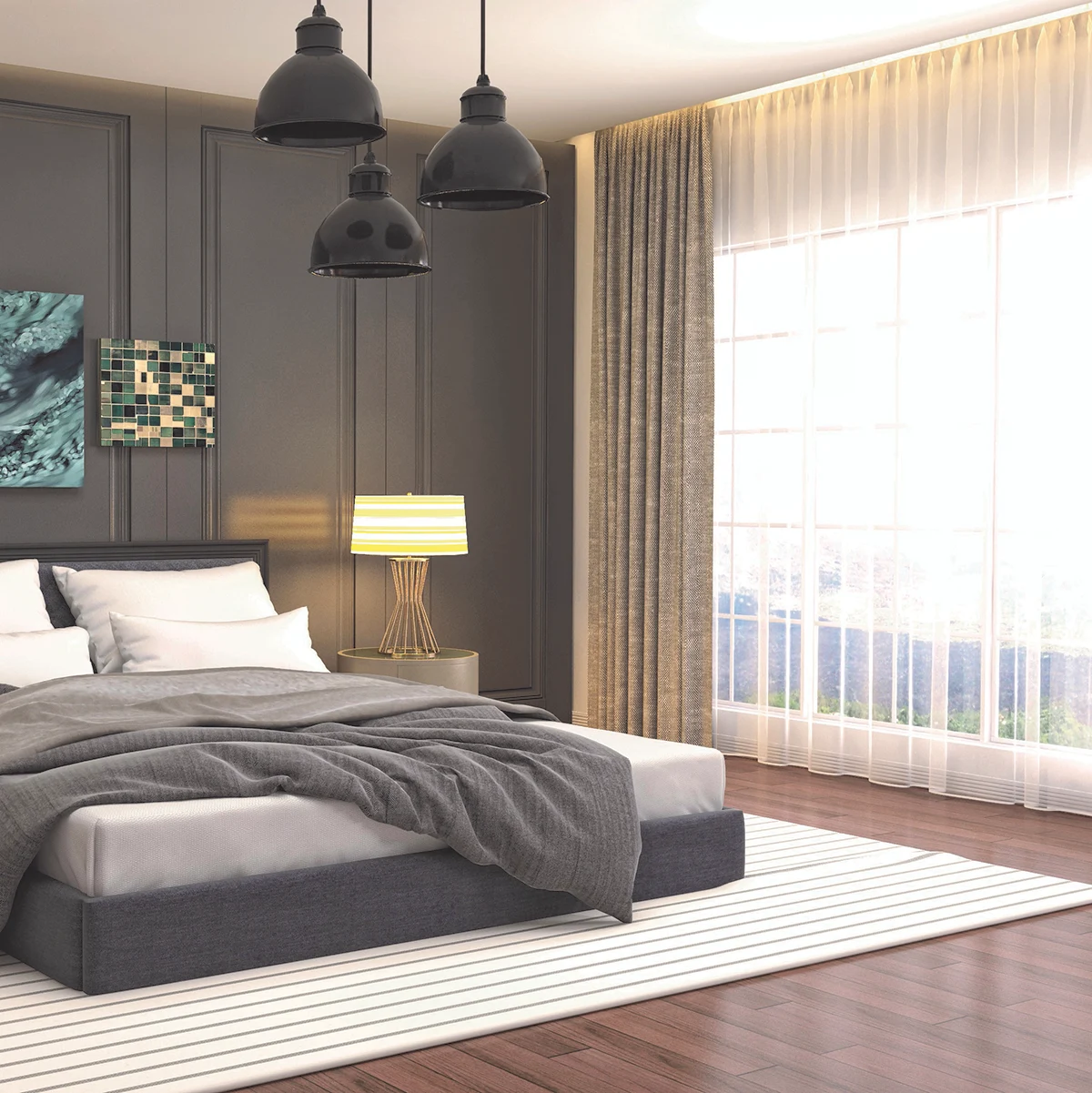
Dark floors can carry a bolder curtain, and you have two honest options.
- Go lighter to lift the room. A pale, soft curtain against a dark floor creates contrast that makes the space feel taller and brighter. This is usually the safer choice in rooms that don’t get much natural light.
- Go deeper to enclose it. Charcoal, deep olive, warm clay or a rich neutral makes a room feel intimate and considered. It suits formal living rooms and main bedrooms far better than it suits a compact space.
A polyester and viscose blockout works particularly well over dark timber, because the slight sheen catches what light there is rather than flattening it.
What Curtains Work With Hybrid Stone-Look and Vinyl Floors?
Cooler tones, and smoother fabrics. Stone-look hybrid and vinyl floors usually sit in the grey, concrete and pale stone family, which is a cool base. Crisp white, soft grey, pale greige and muted blue all read cleanly here, where the same shades would fight a warm timber floor.
This is where 100% polyester earns its place. Its smooth, even drape suits the clean lines these floors tend to sit alongside, and heavily textured linen can look at odds with a stone-look surface. If you’d like the background on how these floors are built, our guide to hybrid flooring covers it.
What Curtains Work With Carpet?
With carpet, texture is the conversation rather than colour. The room already has softness underfoot, so adding a heavy curtain on top can tip the whole space into fabric overload, where everything absorbs light and nothing has an edge.
The move is to lighten up. A sheer, or a blockout in a lighter weight, gives the window some definition against all that softness. On colour, pick up a tone from the carpet rather than repeating it: if the carpet is a warm greige, a curtain two or three shades lighter in the same family will read as intentional, where an exact match reads as an accident.
Should You Layer Sheers and Blockouts?
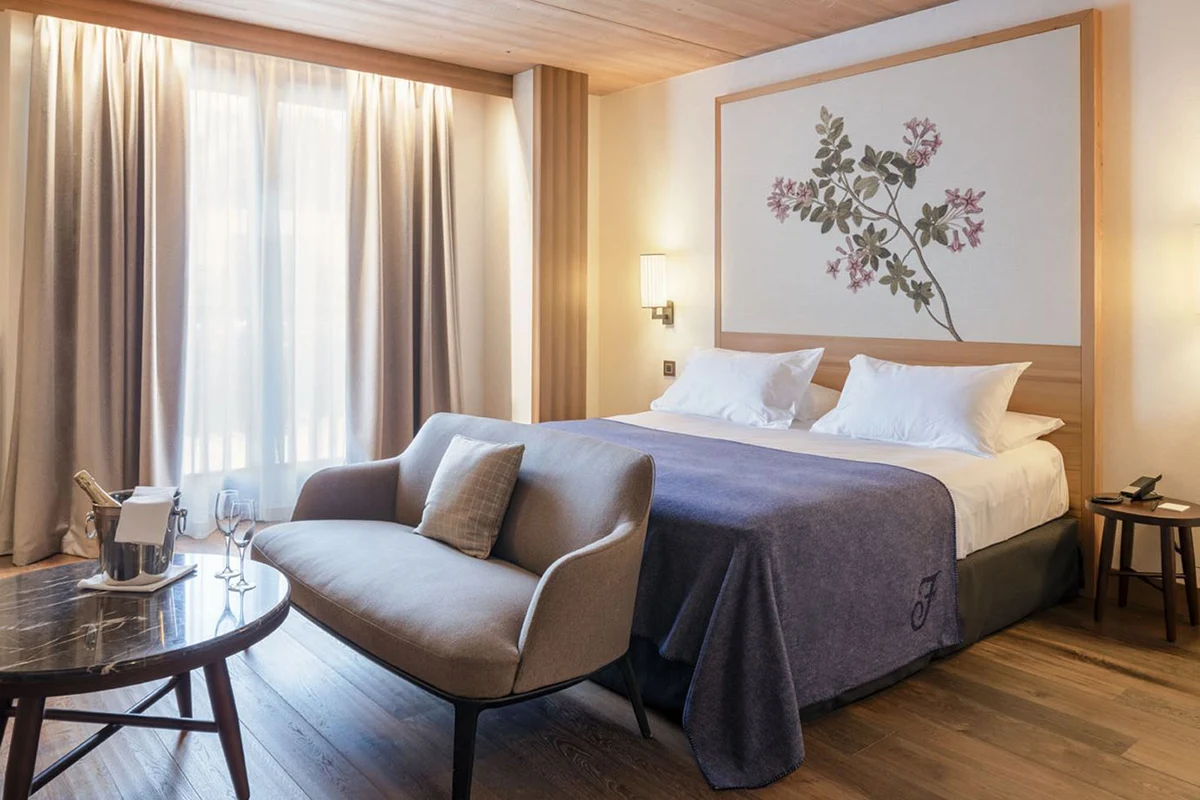
Often, yes, and it solves the pairing problem neatly. Layering lets the sheer carry the texture that works with your floor while the blockout carries the colour and does the practical work of light control and privacy.
You’ll need a double track, so it’s worth deciding before your curtains are measured. Our guide to choosing between sheer and blockout curtains walks through how the two compare and when layering is worth it, and the blockout curtains range covers the weights and colours available.
Common Mistakes to Avoid
- Matching the floor exactly. The most common error, and it flattens a room rather than pulling it together.
- Choosing from a screen. Fabric colour shifts dramatically depending on the light in your room. What looks warm white online can read pink or grey on your wall.
- Forgetting the walls. The floor and the curtains are only two of three surfaces. A pairing that works in isolation can fall apart against the wall colour you already have.
- Hanging too short or too narrow. Curtains that stop above the floor or barely clear the window frame undercut the whole effect, whatever the fabric.
- Letting both compete. A heavily patterned floor and a heavily patterned curtain will fight. Let one lead.
How to See It Together Before You Commit
The honest answer to almost every question above is that you can’t judge it properly until the fabric is in the room. Light changes everything. North-facing rooms get the most direct sun in Australia, and a fabric that looks soft and warm in a south-facing bedroom can read washed out in that light.
That’s what our free Shop-at-Home service is for. A consultant brings the samples to you, so you can hold them against your actual floor, in your actual light, at the time of day you’re usually in that room. It’s obligation-free, and it’s the step that most often changes someone’s mind about a colour they were sure of.
If you’re still choosing the floor itself, the Room Visualiser lets you upload a photo of your room and see how different flooring options look in it before you go any further.
Final Thoughts
Your floor and your window furnishings aren’t two separate decisions. They’re the two biggest surfaces in most rooms, and they either work together or they quietly undermine each other. Coordinate the tone, be deliberate about the contrast, and pick a fabric with the right texture for what’s underfoot, and the rest tends to follow.
If you’d like a hand putting the two together, book a free measure and quote and we’ll bring the samples to you.
Frequently Asked Questions
Either works, and the choice depends on what you want the room to do. Lighter curtains lift a space and make it feel taller and brighter, which suits rooms with dark floors or limited natural light. Darker curtains make a room feel more enclosed and intimate, which works well in formal living areas and main bedrooms.
Neither, strictly. The most reliable approach is to let the curtains sit between the two, sharing the floor's warmth or coolness while staying close enough to the wall colour that they don't jump out. If the walls and floor are already high contrast, keeping the curtains close to the wall colour usually calms the room down.
Cool neutrals work best with grey floors. Crisp white, soft grey, pale greige and muted blue all sit comfortably against a cool base. Warm creams and yellow-based whites tend to clash, because the warmth reads as a mismatch rather than a contrast.
Yes, particularly with a plain, even-grained floor. The thing to watch is that heavily grained or patterned timber, like a strong herringbone, already gives the room visual movement, so a busy curtain on top can be too much. If the floor has a lot going on, keep the curtains plain.
They do, and the contrast is often the point. A pale sheer against a dark floor keeps the room feeling light and open where a heavier fabric would close it down. For privacy after dark you'll want to layer a blockout behind or in front of them, since sheers alone won't do that job once the interior lights are on.


